Here at the Pulpit in the Sky, it is VBS week and the new Vicar has been working the registration table. The first night, a swarm of parents and kids from our parish and the Episcopalian church down the street swept into the parish building- the energy is infectious. We had also canvassed the neighborhood to invite kids and their parents to join us for our meal and the program which includes a program for adults while the kids are off doing their thing. We are studying four different parables- the Good Shepherd, the Good Samaritan, the Sower and the Wise Builder. The first night I was thrilled to see a couple women from the neighborhood come with their children. And our Liberian refugee family with their children. Then came a woman who attends our free breakfast for the needy on Sunday- she wanted to drop off her granddaughter. I invited her to stay and join us for the meal- she went out and told her daughter to park the car- and they stayed and ate, and went to the adult Bible study. A couple of Ethiopian girls from around the corner came too because they heard other kids saying there was this meal and fun at the Lutheran church.
Last night they were all back and the Ethiopians brought two other friends because it's more fun with more friends! And some of our neighboring Latino families came. All at tables with some of our families who have adopted children from faraway places and those who have lived here their whole lives.Without all of the boundaries we sometimes place on our connections.
We had more unexpected visitors from more unexpected places than we thought which temporarily stressed the ladies of the kitchen. Here in the land of "one can never have enough food for guests", we did not have leftovers- we did however, have enough of what we needed. And one can never have enough of what we experienced. The singing, the laughing, the learning and the sharing, and sometimes when someone is a little down, a welcomed hug. Living the parables we hear.
I give thanks for the children who shepherded their friends here, for the chance to plant seeds for the future, to be the meal and the love that beats whatever the world is dishing out and show that you can believe there is another way because you see it lived. Thanks be to God!
About Me
- Law+Gospel
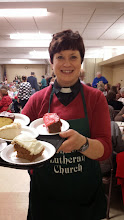
- I'm a proud 2011 graduate of Lutheran Theological Seminary at Gettysburg and the Pastor of Christ Lutheran Church continuing the journey that God has planned. This is where I somewhat regularly contemplate the intersection of faith and the real world, and the tension between law and the Gospel. I am blessed with a wonderful husband, two Lutheran Chicks and Toby, our beagle/pointer mix! And now for the legal lingo:Views expressed here are mine alone, and do not represent the ELCA, LTSG, or any ministry context in which I serve or to which I belong. The names in my stories have been changed to protect the innocent, as have key facts. If the story sounds familiar perhaps it is because life experiences can be universal.
Wednesday, August 12, 2009


Monday, August 10, 2009
Gnawing Hunger
John 6: 51-58
There is a distinct difference between eating fast food in haste versus savoring a meal that is not inhaled, but is a gnawing to get to the deepest part. It is a little bothersome to imagine loud gnawing and lip-smacking at the altar rail during communion, much less the image of gnawing on real flesh and blood. After all we have developed ways to make this part of the worship experience much more regal and refined. We have processes for the elements to be distributed uniformly, with as little human contact in the serving as possible. We process forward as directed, and take just enough time to receive the elements and move on. Taking time to say "Amen" is pushing the limit- we are mindful of the length of the service. We have elaborate and lovingly tended communion ware, and linens. Robert Capon [Hunting the Divine Fox] writes a bit about our modern spiritualizing of the sacrament:
Jesus instituted the sacrament of his body and blood by commanding his disciples to eat bread and drink wine in remembrance of him. Human nature being what it is, however, it wasn't long before someone got the idea that the bread for the sacrament ought to be something special. It wasn't enough apparently, that by Jesus' own words, any old bread would be nothing less than his true, risen and glorious body really present in a high mystery. They had to have super-bread. And so in accordance with Murphy's Law (if a mistake can be made, it will be), the angelic fish-food communion wafers were invented, snow white, unleavened, crumbless, odorless and tasteless. And made by nuns. Out of rice flour. Without salt. In little waffle irons with holy monograms on them. [p. 125]
Somehow all of these centuries later, we would prefer a more sanitized and efficient experience. But the experience of the gospel repeatedly shows that God is instead using the humble and ordinary in extraordinary ways. Incarnation by a fleshy birth in a filthy stinky manger or cave- as unclean and impure as we can imagine. Ordinary common bread from a street vendor whose hands are calloused and whose fingernails are ragged and dirty. Wine made down the street, not from the finest Napa Valley vineyard. All of this talk about flesh and blood, the very things that shock consciences and certainly appalled the Jewish leaders- so much so they didn't just quarrel lightly, they were fraught with deep simmering conflicts that erupted from the core of their being at Jesus' words and life. Because what Jesus suggests is not how it is supposed to be- it violates all laws and standards. We too have created laws and standards of how we expect things to be. Even now we find it hard to imagine God using these means- these shocking, at times repulsive means of the incarnation, death and resurrection to bring what we need most deeply. We don't want to ponder gnawing, messy or gritty. No matter how gritty life can be, it is not God who shocked and offended by the earthiness of it all, but it is us. Maybe we don't want to go that deep.
But Christ is abiding in us in the depth of our humanity. Not just stopping by, but taking root deep within us. These images convey depth of relationship. Our relationship with Christ is not superficial and external, not temporary or" for this day", but at the heart and core of our existence, and is the heart and the gift of the Eucharist. Brian Peterson writes that today's gospel passage is about the fact that the Eucharist is life giving and that it is because of Jesus' incarnation that it is life giving. But more importantly it is about the fact that the Eucharist is life giving because it draws us into deeper relationship with Christ. "I abide in you and you in me" suggests a union of relationship- more than the fact that when we celebrate the Eucharist the elements enter us. Food does help to sustain life, but it is about how we are altered by the life-giving of Jesus in ways that transcend the caloric value of eating and drinking. We are re-ordered by Christ.
Can we allow in our minds that we hunger? There are many things in life for which we can be said to hunger. Things that compete for our hearts and minds and draw us in many directions. We may think they give us a new experience or new thrill. Out of this thinking comes the "List of 100 places you must see before you die" and other ways of identifying what we just HAVE to do. But just like that manna, they are for this day only. Though we can hunger for them to be more, by nature they cannot be. They cannot give the life we need most no matter how many times we try.
To satisfy our deepest hunger, it takes Christ. What if we truly hungered to get to the deepest level of this relationship? What if as much as we consume, we are consumed by this motivation? It would alter our very existence. And in the depth of that relationship, we would be drawn to those people and places we might prefer to not contemplate. Then not only would we be fed, but it would open our eyes to all of those who this day hunger and thirst. And if Christ is in us we could not stop ourselves from reaching out with that bread of life for all. It would gnaw at us and we would hunger for all to be fed. We would feel it in our very flesh, in the core of our being.
Friday, July 24, 2009
Life in Ministry
I am beyond excited that I have moved into my office, officially called a "study." It is, shall we say, cozy. As wide as my bookshelf and endtable. As deep as my second chair and desk. But, with all of my books and pictures, crosses and candles, and my fun toys- squirt gun, light up antlers, Action figure Peter, and Clap for the Lord clappers, it is just right. My message board on my door playfully invites people to complete the sentence- The Vicar is ______________. I have gotten the handful of keys, the secrets to the phone system, and my vestments joined the others in the sacristy. I am told the sextons bring us cookies on Sunday! I had gracious help in moving in and found a cheerful Welcome sign above my desk, a ready laptop and printer and a tote bag in case I want one for carrying things around or going to the Farmers Market which I can walk to. I have been blessed with a wonderfully exuberant and supportive Internship Committee. I will be installed, will offer the benediction and then the adventure will begin to unfold.
It is an amazing time.
While I ask for your prayers as I embark, I also ask for prayers for a pastor in our synod who is experiencing a much different life in ministry. A year ago, he was called by a member who told him that the member's wife had been found dead in the pool. Murdered. Within mere hours of processing this loss, and attempting to walk with the husband, investigation led to the husband's arrest and charging. How to minister to a family in loss and also to one accused and whose fate hangs in the balance. A year later the trial has begun and the pastor was called as a witness and asked whether he knew the husband was having an affair at the time of his wife's death, and what his perception was of the husband's grieving or not grieving the loss of his wife. (The husband admits the affair and his child with the other woman was born this spring). I have been a lawyer, and a witness in my life. I have counseled others. I can only imagine what this pastor must be experiencing. Multi-faceted grief and stress. SO I ask for prayers for his care in the midst of his caring and ministering. The adventures of minstry can unfold in many ways- none of us ever wants to think it will look like this.
Thursday, July 23, 2009
Ref-Lectionary Musings: Not What We Expect
“If you do not believe the words of Moses, how will you believe my words?” After this stinging indictment Jesus has left the Jewish leaders. He goes away across the water to Galilee, and up the mountain with the disciples. Perhaps he has gone there to have time away, time with the Father, time for teaching the disciples. What we know is that he is soon thereafter aware that a large crowd is coming to him. They are not coming to him for what he has said. We are told they are clamoring to be with Jesus for the miraculous signs he has performed for the sick. For the restoration of lives that this healing has brought. In the lives of the Hebrew people, there was not a bright line between life and death, but a continuum in which one who was chronically sick was seen as not really among the living. For many this sickness placed them outside of the temple community- one would give anything to be restored, to be made whole, to be reinstated into life in community. And one would give anything to be free from whatever pain and suffering life involved. Jesus perhaps was the latest of those who the people followed desperately seeking relief, and many before had proven to be charlatans. There were in excess of five thousand people, a number as large as or larger than a lot of the towns in which we ourselves live today- Over five thousand people swarming to get to their hope for healing.
If I was one of the disciples I would have been wondering how on earth would this throng of people be able to be organized into a manageable system. We would need to triage the situation and determine who had the greatest needs. We would need crowd control. We would need a “take a number” system. We would need more than 12 of us disciples to keep this all from becoming a chaotic mess. So many people to be healed. How long would it take? Out of chaos will come order, and God will provide, but not in the way the people ask.
In the face of this massive influx of needy people, Jesus is not focused on their physical ailments. Instead, he asks how they will all eat. What? Imagine that you have been crippled since birth, or have sores that won’t heal, would the first thing on your mind be- I am hungry? Jesus asks where will they get the bread- he already knows the miracle that he will perform.
The miracle of the feeding is even more stupendous in the multiplication. Nothing was wasted. And seemingly out of nothing God creates something. Everyone has not just a crumb and pretends they are not hungry. Everyone is satisfied. We don’t know how much they ate- maybe it was just a crumb-but the bread from God is sufficient in a way that the bread from the labor of our own hands can never be.
Phillip has been hearing Jesus’ words, and seeing Jesus’ signs and yet, he has not yet taken that quantum leap to fathom that for Jesus, son of God, nothing is impossible. In the days of yore, the manna, bread from heaven, would have seemed impossible. Yet it would be enough. Now the source of the bread was in our midst, creating in ways that seemed impossible, and yet it was enough.
And by not only joining in community but inviting these unclean masses to eat together with Jesus and the disciples, this breaking of bread and sharing of a meal functioned as purification, and restoration into community, the thing their sicknesses had prevented. They were made whole in community, welcomed by God and fed.
There was no picking and choosing of the worthy, no words of limitation, but sufficient abundance for all- no questions asked. No litmus tests, no separation. Everyone sat down- together. Everyone was fed. Everyone was restored. Everyone was satisfied. We don’t know if they were physically healed. But I think they were rescued from a world that was overwhelming and given peace.
They were overwhelmed with it all. They responded the only way they knew how- to try to acknowledge Jesus with earthly power, to make him the king. They wanted to overthrow the system that had failed to help them- they wanted a king like this. It is really pretty treasonous to think such thoughts, much less say them. But just as Jesus provided not what they wanted but what they needed in the breaking of the bread, so he left them now. It is for another day that he will give the people what they really need in a kingship that looks nothing like what they imagine.
So many times we can make things far more complicated than they need to be, with rules and trappings and procedures. Yet it doesn’t get much simpler than this. People gathered right there on the grass. Nothing fancy. There were no cadres of ushers who marched down aisles at just the right time. No one telling antsy kids to be quiet. No one seemingly concerned with sitting in their “usual spot.” Just people who were glad to have Jesus in their midst, to share and be fed and be satisfied. And to dwell just a moment in the awesomeness of this wholeness, this community and in the extravagance of God in our midst.
After the miracle, Jesus again withdraws to the mountain and the disciples and crowds go on their way. Soon enough the worries of the world return, the storms on the water return. The disciples are not sure what THEY can do. Jesus comes again to them, showing that our hope is not in what we can do, but what God does. They want Jesus in the boat with them, but instead the boat is suddenly at the shore. Not what they asked for, but what they needed. This time multiplying speed to safety instead of bread. Out of chaos, order and rescue from a world that is overwhelming.
The disciples thought they were alone, just as each in the crowds probably felt alone in his or her sickness. Jesus provided presence and restoration, for the crowds when they sought him; for the disciples, he came to them even before they asked.
Whether we are in worship because we always come, whether we are here today because we seek an end to chaos, each of us is seeking something more than our daily labors alone can bring. Each of us is hoping to encounter Jesus. Presence, restoration, wholeness, healing and peace are here, for each of us, in ordinary things, in the bread and wine. No matter who we are or where we have been, God’s extravagant abundance is here for all. We can believe these words. Come.
Tuesday, July 14, 2009
Ref-lectionary musings- Shepherding
In Jeremiah 23:1, 2, 4, we hear about the deficiencies of earthly shepherds. “Woe to the shepherds who destroy and scatter the sheep of my pasture!” says the LORD. “It is you who have scattered my flock, and have driven them away, and you have not attended to them. I will raise up shepherds over them who will shepherd them, and they shall not fear any longer, or be dismayed, nor shall any be missing,” says the LORD. “Shepherd” is a word with more than one meaning.
Shepherds are responsible for protecting and providing sustenance for their flocks, keeping peace within the flock, defending against attackers, searching for sheep that have gone astray, and rescuing those who are in danger. The shepherd, and by analogy the king, is expected to act for the well-being of the sheep. Though we can think about actual shepherds who tend livestock, more importantly, what does this mean for those of us who serve in shepherding roles in the Church? What is the sustenance we should be offering? What would the good shepherd look like in our humanity? Attentive to justice, protection, mercy, and righteousness, for sure, but I think there is more. I think it is about more than just physical sustenance and care, but about providing direction.
In Psalm 23: 2, 3, 4, we hear of the Lord as shepherd:
He makes me lie down in green pastures; he leads me beside still waters;
He restores my soul. He leads me in right paths for his name's sake.
Even though I walk through the darkest valley, I fear no evil; for you are with me.
As I focused upon the teaching aspects of shepherding, I was drawn not only to the “leading” and “directing” but to seeing that it is because of this leading and teaching that the psalmist can sense that the Lord, not a physical person, is present. This presence sensed in one’s internal being, that whole sense of life, not just the physical, that is contemplated by the Hebrew word, nefesh. By being able to rely upon this teaching felt as presence within, the psalmist can overcome fears and can sense that caring and providing. The rod and staff that at times prods us forward, and at times draws us back to where we can have life.
So when I then contemplate Mark 6:54-56, and Jesus as shepherd, the imagery again is about more than physical care. “As he went ashore, he saw a great crowd; and he had compassion for them, because they were like sheep without a shepherd; and he began to teach them many things.” Jesus has compassion- one of my favorite words in Greek, splagchnizomai. It can mean sympathy, mercy, and loving concern, but my favorite part about it is that it is deep inner core emotion, the same visceral gut emotion of the father for the lost son in the story of the Prodigal. In the depth of this sense of caring, it seems to be more than tending to people who are sick and need a physical cure because the compassion is connected to the first then we are told Jesus does, to care for the inner being, and a sense of being “with” that person. "They were like sheep without a shepherd." There are lots of modern metaphors for being lost, but I tend to think of the concept of being at wit’s end.” Feeling totally dependent and totally abandoned- that no one is with us. That feeling that no amount of Band-aids, hugs or things done “to” people can erase. That deep “in our gut” feeling. Maybe Jesus is matching our feelings, gut to gut. What does Jesus do? "…he began to teach them many things" (Mark 6:34). Deep down we need more than a quick fix, we need a roadmap. In The Wounded Storyteller, one person whose world has been turned upside down by chronic illness talks about a sense that the roadmap he had been using in life suddenly becoming worthless, and that sense of existential despair; of having no way to navigate the journey. POW’s who have survived imprisonment are often found to have survived emotionally by recalling Scripture, liturgy, and hymns as a way of sustenance. Persons with dementia continue to find comfort in the same. I remember one older gentleman whose sense of reality was robbed by dementia. In many ways much of his day was spent in some world only his mind saw, and he was often agitated. But when he was brought communion, he would suddenly spring into the words of the liturgy as he had his whole life. And for the length of that time, and whenever we would recite his favorite Scripture, he was not that lost sheep. So it would seem to make sense that the Gospel would be critical to giving that sense of direction in which one finds the presence of God, and the caring of God that allows one to rise above fear- the Lord as shepherd in what has been taught and internalized. When I think about the compassion Jesus felt which led him to teach, it made me ponder- that teaching is what we keep in our hearts and minds. Which is worse, facing some physical concern, or facing that sense of being lost with no one to turn to and no roadmap for the journey? My experiences in chaplaincy tell me it is the latter- our hearts and minds can be awfully empty places without the word/Word to cling to. I have to agree with Mark Vitalis Hoffman who encourages understanding “education as an expression of compassionate evangelism. Yes, there are all sorts of ways we can express compassion by attending to the pressing physical needs people have, but it is just as important for us to be educating them by clearly and faithfully speaking the Gospel.” I can’t say it any better than that.
Sunday, July 12, 2009
God's Work, Our Hands
Here is an inspiring video created by Jacob Smith, husband of my friend and LTSG grad, Pastor Erin Boyer Smith. It is an entry in the video contest of the ELCA. If you are inspired too, please consider voting for it by going here:
http://bit.ly/Hfj4S.
I give thanks for all of the hands of all of God's servants- together we can do some pretty awesome things as the graced and empowered.
http://bit.ly/Hfj4S.
I give thanks for all of the hands of all of God's servants- together we can do some pretty awesome things as the graced and empowered.
Thursday, July 9, 2009
Daring to Cross Boundaries
This Sunday I preach in my home parish as my last Sunday before beginning internship:

Have you have ever said “yes” to a job, or a project, only to discover it turned out to be a whole lot more than you bargained for? I once had a friend who excitedly signed on for a job in a Big 10 accounting firm that gave her a great salary and power, but included “opportunity for travel in a fast paced environment.” In other words she was asked to do too many things in too little time, and she saw her house about once every two weeks for a day and half. Long enough to do her laundry, go to bed, get up and do it again. She just didn’t really believe it would be THAT fast-paced. Often in the excitement of new work, we convince ourselves that part of the job may not actually be expected or if the time comes, maybe “someone else” will do it. Truth is- we don’t like to have our expectations, our boundaries challenged.
We live in a world of boundaries, boundaries used to keep order; to keep things in and to keep others out. Some boundaries are imposed upon us by others, but just as many are created by each of us- Ways we stretch that bright yellow “DO NOT CROSS” tape across our world to create control and influence and power. Much of the Gospel of Mark is about the crossing of these human-created boundaries and how God’s vision of the order of the world is often vastly different than our own. Almost immediately in Mark we hear about John. He crossed lots of boundaries, of where he lived, how he dressed, what he ate and in having the audacity to challenge the powers that be. He was sent to prepare the way- for another who had been sent. This one, Jesus, would cross all boundaries, gathering and then sending others, who would send others, right on through to today, all part of a divine mission. But as I said, God’s vision is vastly different than we or those in power may think. We the audience of the story get a second warning about the gospel challenge to power and what people do out of the desire for power, and how changing our view of power and living involves more than we might wish.
In an early example of truth in advertizing, the disciples were warned. They were called and sent out and do miraculous things, but Jesus warns that not everyone will be receptive. There will be challenge. But as they go about they sense a great buzz of excitement in the preaching, teaching, baptizing and healing, and it feels… powerful, not challenging. This “Jesus movement” is growing! This is when Herod gets wind of the movement, a movement that if it flourishes will challenge the power structure, economics and status, will promote equality not hierarchy. . Herod flashes back to the last time he heard about preaching, teaching, and baptizing in the wilderness, and remembers John. Who is this Jesus, these new followers, threatening boundaries, challenging the way things are? Our story shows what happens when those at the top feel threatened, and what will happen when the faithful call out hypocrisy, and remind people of what is lawful or right, and shine the bright light of day on the dark recesses of culture.
It’s like a TV drama- and Herod is a pretty tragic figure. He didn’t actually have much real power- only a title. He didn’t have charisma, only a structure to demand attention and to keep things the way “they should be.” To top it off, he had the title of king, but he was really working for Rome- having only the power that others gave him. As one of four sons of Herod the Great, none of whom inherited the whole kingdom, he was “Herod the Not So Great.” In his world of buying and selling influence, truth was optional. John had the nerve to enter this world? Cross these boundaries? Herod was fascinated, mesmerized that John cared nothing for power, or influence and fearlessly spoke the truth. Though Herod feared the truth, he was both drawn in and perplexed by John’s message.
Herodias was perplexed too, but in a different way. She didn’t have the power either, but she wanted it desperately. She and Herod left other marriages to be together- he probably was motivated by desire, but she may have traded up for a better kingdom. She held a grudge against John – how dare he mess with her world and called her path to marriage what it really was! It was obvious to her that John would just keep coming back unless he was silenced for good, but how? How to get to Herod? She devised a new power source- a new temptation- She sent her daughter to dance before Herod. Pictures often depict the daughter as an adult, but historians tell that this real person was probably about 12 years old. Herod was enthralled- lost himself for a moment- had to have this new toy. Used to offering money and connections to get what he wanted, he forgot that she was 12, and offered the girl “whatever she desired.” Caught in an adult game, she was too young to comprehend power and the desire for it. She had no idea how to respond, but Herodias did and we know how that turned out for John.
In the midst of this world, John didn’t fit the mold of the powerful. He was using a different power source, and an entirely different view – a God’s eye view that shaped his living, leading him to confront Herod. This was not a one time conversation, but in the original Greek, is depicted as a much more intense experience. John told Herod repeatedly, over and over again, like a haunting whistleblower. Not once , not twice, but repeatedly stepping into this world ,where to all others it would seem he should be smart enough to keep his mouth shut, and go back where he came from. And Herod is repeatedly confronted by John with his own guilt, even after death.
Herod, seemingly a man of great power, lacked the power to stop the lunacy that ended with John’s death. Because he couldn’t change his power source or his view- he chose silence and complacency, because it was too awkward to stand in the face of desires, his own and those in his midst. In the world of power it makes no sense what John did. He risked it all by using this different view of the world, and by continually sending himself across boundaries. In our modern times, there have been new faithful voices against corruption, oppression and wrongdoing- like Oscar Romero in Latin America, Dietrich Bonhoffer in Nazi Germany, and many others. Some like John have paid with their lives for standing up to power and influence, and for some Christians around the world today, discipleship is a life and death struggle- but for most of us the struggle is more internal. Yet we are asked what boundaries will we risk as the “sent out”? Will we risk our own sense of comfort or power?
Thinking again about today’s lesson, where do we see ourselves? Are we John, willing to risk, continually speaking and acting? Or are we the disciples who comfortably think they have the mission under control only to discover there is more to it? Are we at times the Herods and Herodiases of our context? Caught in our own desires for power and holding grudges when others mess with our world?
Probably “all of the above.” At varying times we are each of these. Sometimes we want to act, but we allow the world’s view to cause us to be silent. Sometimes we are angered by those who want to change our worldview- who challenge us. Sometimes we lack the energy to keep up the effort, or we are surprised when we face resistance and we lose our nerve.
What does this say to us about the walk of discipleship? That discipleship is a life in tension, both within us and in our culture. Our culture today and some popular religions tell us that with the “right life,” we will receive abundance and prosperity, and material success, that God will bless US. That he who dies with the most toys wins. That we can claim that “God is on our side” in the world’s game of power and influence. Yet today’s gospel says that discipleship is not an end to troubles, nor the key to financial success, nor the roadmap to great power and influence. In fact, we are reminded that the message of the gospel is decidedly opposite. Those who have power, as measured by the world’s standards, don’t want to hear the gospel challenge- and there will be consequences. Today’s lesson is not a good ad for seminary. But it is not an easy lesson for any of us who make up the priesthood of all believers- because we are called to cross boundaries- to engage in a life that challenges us and others to let go of our boundaries and our desires that sometimes lead us to distort facts; to hoard more than we need; to oppress;, to insist upon having what we want when we want it, regardless of the way we get it. We are challenged to let go of the boundary of our own need to control – that leads us to choose silence, or complacency, or choosing to only care for those we find it easy to care for. We are called to challenge those who suggest that things that are wrong can be overlooked for expediency. This challenge is not limited to “great heroes of the faith,” but for all of us, disciples sent out with a message.
Our discipleship is a life of joy and challenge. Being a disciple involves times of being sent out in great enthusiasm and joy and the rush of seeing it all come together. But being a disciple will also involve disagreement, struggle and rejection of the message we bring. In our life as disiciples, will we choose to stand with others in the face of social injustice? Or will we choose complacency? Will we speak against wrongs in our world, in our community, in our very midst? Or will we be silent, deciding that unless we are individually, personally affected, that there is nothing we can do? Are we willing to question how the power to make choices in our daily lives can affect the very lives of others, in the things we buy and consume and the policies we embrace? Are we willing to speak truth to power, or will we just keep our heads down?
And today we are asked to consider not only whether we will speak and act, but whether we will keep speaking and acting, like John, or will we say, “ I did that once, let someone else take a turn”? Do we want to gather and be sent, or just to stay put? It is challenging to speak and act with truth and integrity, standing in the face of all of the world’s desires. How will we respond if some in our midst mock us for our stance, when we answer a calling that does not mesh with the ways of the world as we know it? When we think about this are we still willing to be sent out? Still want to be a disciple? Hard questions.
Our youth are responding to this challenge and will confront these very questions as they are sent out to NOLA. Some may think that the Youth gathering is a great social event, and it is, but it is also first and foremost a chance to serve the least. This gathering is intentionally identified as a servant event that confronts and addresses illiteracy, lack of housing, lack of resources for clean water, the inability for some to have really fundamental things we take for granted here. To face racism, class-ism and social prejudices head on. To stand toe- to- toe with people of whom one could say- “they are so far away, they’re not like me”, or about whom we could say “it’s the government’s job to take care of them, isn’t it?” I suggest that these statements are all expressions that some use to try to justify not speaking, not acting, not sharing and not standing with our brothers and sisters in Christ. It would be easier to stay home, but our youth are disciples being sent out as messengers, to teach, to heal lives, and yes, to preach. Living out the words of St. Francis of Assisi who once said- “Preach the gospel. If necessary, use words.” They will be risking their understanding of the world; they will be risking the raised eyebrows of some who think that it is not worth risking comfort and safety, much less the cost. They will be at times challenging others and they themselves will be challenged.
Just as John kept telling, discipleship is not a story told once and then not heard again, but a mission and message across time- to continue to cross boundaries for the sake of God’s kingdom. So, when the youth return I urge you to hear their stories not as a single moment in time that is now ended, but as a story that keeps being told-as guidance for your journey into the future of this congregation together- to be open to new ideas, new challenges; to be open to being activated by the Spirit- commissioned and sent, even if this challenges your world, your desires and your boundaries. Called not only to gather, but to be sent out again and again and again, living out your baptismal identity.
This living challenges our boundaries. When our boundaries get the best of us, may we give thanks to God for the grace shown to us. But may we not be lulled into believing that grace is the only word we hear. We are saved by grace, but God desires that we are not only to gather and be still, but to live out our baptismal calling daily. It is a challenge to follow God’s calling wherever it may take us for the sake of the kingdom, but may we also remember that power source that will sustain us in the many journeys in discipleship.
So as we leave this day, our journeys continue -For many of our youth this journey will soon involve being sent out to NOLA; for myself, it involves being sent out to Trinity Lutheran in Lancaster City. For each of you, it will be wherever God will send you. Wherever the journey takes each of us, may we be willing to risk, trusting in God, graced and empowered to go beyond our own boundaries for the sake of the kingdom.
Amen
Subscribe to:
Posts (Atom)