I cannot change the weather, or the fact everyone is still passing around nasty illnesses. I cannot change the fact I want to be in my garden and can't, or the fact that I am tired of sweaters. I don't want to run the heat anymore- I want to open the windows. I want to fire up the grill not the soup pot.
I can start my seedlings and eagerly await their little green shoots in the starter tray ( I still get a smile when they first poke their heads up out of the potting mix ( this summer they will hopefully be tomatoes and peppers!) I can change my blog template to at least reflect that spring green is one of my favorite colors. Such a simple thing, like moving a chair to a different place in the room. But today - a new outlook! I am tired of the wind and more than a little dismayed that this will undoubtedly be the weather for the 6 AM Easter sunrise service in the cemetery at the country parish on top of the hill.
This past Sunday I practiced with the "Ladies ( and now 2 Guys) Who Sing" - the Easter music. They also practiced music for this Sunday. The song is cheerful, and in the third line the "Alleluias" start, and are pretty much throughout. For Passion Sunday- not so good. After a kind and patient discussion, it is agreed to change the "Alleluias" to " Hosannas." And everyone is pretty much OK, but the truth is- they really just want to get to Easter. If only we could just run by all of the cross and suffering stuff and get to the happy ending. After all, one person said, "Aren't we an Easter people?" And what difference does it make really?
It is a little ironic to me that as a culture we have become obsessed with death, real time news, HDTV graphics, and knowing everything we can about people's lives. But the one story we fear to face, the most important story, we would just as soon not. Luther's affinity for theology of the cross not withstanding, many of those who today worship in the church that bears his moniker would just like an extra helping of grace, thank you very much.
So I talked with the Ladies and 2 Guys and explained what this Sunday is about. Not just Hosanna and kids waving palms. Not just knowing who has what lines in the narrative reading. But that this Sunday we focus on the Passion, the selflessness, the suffering and ultimate love of God on the cross. Do we really want to sing "Alleluia" as a word of praise for the mocking, or the suffering or the humiliation, or the killing of Christ?
We can hear the endless drone of sad statistics about the dead in a senseless war, the dying who cannot get food or medical care or clean water, and we are numb to it. But ask us to imagine the nails, the thorns and the cross. Not so much.
This week I am reading The Crucified God by Jurgen Moltmann for my systematic theology class. Somehow, just in time. May we be brave enough to linger in the tension of Lent, and then as Easter people, be bold enough to proclaim the mission of the church to and for the oppressed, the afflicted and those who desperately need this Christ.
About Me
- Law+Gospel
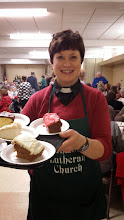
- I'm a proud 2011 graduate of Lutheran Theological Seminary at Gettysburg and the Pastor of Christ Lutheran Church continuing the journey that God has planned. This is where I somewhat regularly contemplate the intersection of faith and the real world, and the tension between law and the Gospel. I am blessed with a wonderful husband, two Lutheran Chicks and Toby, our beagle/pointer mix! And now for the legal lingo:Views expressed here are mine alone, and do not represent the ELCA, LTSG, or any ministry context in which I serve or to which I belong. The names in my stories have been changed to protect the innocent, as have key facts. If the story sounds familiar perhaps it is because life experiences can be universal.
Showing posts with label Passion Sunday. Show all posts
Showing posts with label Passion Sunday. Show all posts
Monday, March 10, 2008


Tuesday, February 19, 2008
Live Within the Text
"Live within the text" is etched in my mind. I am taking a course on Preaching Matthew, which I thought was wise since, for those using the Revised Common Lectionary, you know it is Year A, and I have to preach in my teaching parish twice, and also three times in my preaching class, and I have a Gospels class, in which I have weekly exegesis and a sermon prep. It will all align perfectly I said. Well, for starters, I am not only bound by the lectionary, but also the assignments from said teaching parish and my preaching class. But I think I see the planets align- I am told I am preaching Palm Sunday in the Country Parish and I am preaching this text in advance, so to speak in my preaching class.
Then it hits- pick one thing from the Passion Narrative, preferably not the focus of the Triduum and preach it- and only that, says my preaching professor. I pick the mocking of Jesus. Matthew 27:27-31 for those who want to see it. There is no grace there, only unanswered questions. ( I will be preaching differently in the country parish) but, now that it is done I realize that confronting this text was a Lenten discipline in itself. How hard to stop...stop and focus on just this passage and live there. It may be one of the darkest things I have ever written. But it allowed me to think of others for whom there is darkness.
So, here it is, my living in this text..in all my years I have never so fully contemplated just these five verses of the Passion narrative read on Palm Sunday:
How quickly the readings for today move away from the parade. Today’s processional verses remind us that before we walk through the Passion narrative, there is the parade- the entry into Jerusalem. Jesus attracted crowds, of supporters, critics and the curious. By the time the crowd reaches Jerusalem from Galilee, they have become a wave of humanity pulsing along, from the countryside to the city. And cloaks and palm branches are strewn on the ground. Crowds ahead of and behind Jesus, shouting, “HOSANNA!” There is this claim of hope for Jesus’ mission. Jesus is riding triumphantly on the donkey. An entry fit for a king, hearkening back to the days of the Old Testament with a procession for a conqueror or liberator. Amidst the whipped up frenzy of the crowd- the appointed time was here! Seemingly the beginning of glory and honor and a challenge to power.
But sitting astride the donkey, Jesus knows what the others do not- where the road will go from here, after the parade. There was such excitement in the air, and people craning to see what was coming. But who is this?
The same question asked over and over again, by the Jewish leaders, by Pilate, by soldiers, in the events of that week in Jerusalem.
Who is this King of the Jews?
As the final drama begins to unfold, Matthew’s story will invert, will turn upside down, the notion of who this King is and how we treat him, and will lead to the cross on the outskirts of town.
The betrayal has occurred and the trial is over. The onlookers and disciples are gone. It is after the sentencing and before the crucifixion in The Passion of our Lord.
“Passion” is defined as “the condition of being acted upon”- of letting others do to you; and also the “endurance of suffering.” Either of these speaks of our Gospel for today, of what Jesus knew would and must come, even as He sat astride the donkey.
And now Jesus stands at the mercy of the soldiers, hardly a figure of power.
Maybe the soldiers were acting on orders. Maybe they got carried away, after all, what is a little excessive force when national security is involved? “They say this guy is the ‘King of the Jews’ – that militant on the list.”
Everyone stands poised to play their roles as the players take the stage.
“Then the soldiers of the governor took Jesus into the governor’s headquarters”- the curtain comes up on Jesus truly living out this “passion.” He apparently says nothing, and if he cries out it has not been recorded. He is taken to the governor’s headquarters, located just beyond the temple wall, in the shadow of the Holy of holies.
From his birth, he has been called the King of the Jews, by those who hope that he is not. His mere existence is a threat to the prescribed structure of power. “You want to be a King? We have a way of dealing with Kings here.” Pilate is here because it is the Passover, and we need to keep an eye on these Jews, and their would-be king. He is just in time for the show. He may have even watched the spectacle unfold. This deadly dance happened in the courtyard, not tucked away in some dark dungeon, but publicly in the shadow of the temple.
Just beyond the courtyard, a fence separates the Gentile area ( where the Romans are) from the sacred and holy spaces of the Temple. But a wall of silence allows this macabre drama to unfold..
And “they gathered all of the cohort over him.” A “cohort”, is a type of Roman military unit of as many as 600 men. And with such a crowd for the festival, it was probably close to this number to quell any potential uprising. As many as 600 men--- and one of Jesus. We may have always envisioned a handful of soldiers at most. Not ..600. These men have been fighting the Jewish uprisings. Maybe as writer Tom Wright has suggested, they have seen some of their buddies killed by these rebels. Maybe they are tired of being away from home, and maybe they have been here longer than they thought.
Maybe it is a few who begin, at first, but the number swells as people want to see what will happen with this man who may have been depicted as a dangerous militant, and a rebel. And once the energy of what happens begins, group frenzy takes over. Matthew tells us that these men are not just around Jesus, but over him, both physically and psychologically. The just-flogged Jesus may well have been crumpled and lying in a heap, dragged from one place to another..maybe on his knees before them.. powerless. But, they say he is “dangerous.”
The next thing you know, they are “Stripping him.” This perverse and demented drama includes a costume change. We don’t know if it was immediately that they put a scarlet cloak on him, or whether a part of the sport of it all was the humiliation of nakedness. The king deserving a royal purple robe, forced to wear a scarlet military robe, a symbol of being drafted into service. The king, forced to endure the taunts and jeers he knew there would be.
“Where’s your power now, King?”
“After twisting some thorns into a crown they put it on his head.” The anguish of this mental cruelty is carried out in a slow, protracted hell that seems to have no end in sight.
“And they placed a reed in his right hand.” Not a stick, or a sword, or even an object of substance. A flimsy, breakable reed, which will be bent to the will of another. Used to inflict the ultimate insult in Jesus’ day- slapping his face. What a great way to settle scores. The common Roman soldier is resentful of the hordes of the occupied. Those Jews are always so full of disdain for the soldiers. Well, who is in charge now? Gifts of honor have been twisted by sick humor. And those in charge- will conveniently have no recollection of the events.
“Kneeling before him they mocked him”, the one to whom kings once traveled, who was worshipped with gold, now reviled and ridiculed in this reversal of how it all began so long ago. Now the soldiers pay a warped homage to their victim. And where did they get the reed, and the crown of thorns, and how long did the drama go on as one by one each added his own tribute to the king?
Saying “hail King of the Jews” A juvenile and cruel take on the honor shown to the earthly ruler- “ Hail Caesar!” Maybe they even forced the King to process and receive their accolades. It is the mockery, the repeated mass mockery that is the focus here. Perhaps as one writer has suggested, Matthew is offering to us a commentary about words being the primary instrument of torture. We don’t know what else may have been said, about Jesus, his appearance, his people, his religion, his family, the threats, the lies, this warfare designed to make a man break, to finish the destruction of his soul. What we can know is that it was not one person making one comment, but a swarm of angry, bullying, men, each taking turns in this pageantry of destruction.
Maybe the soldiers calling out “Hail King of the Jews “ have another sick idea in mind, for “Hail “ can also mean “long live” – “Long live the King- the one we are about to kill.” And at that moment, Jesus may be wondering just how long the torture will go on. And like other torture victims, he might begin praying for sweet death to just come.
Physical taunts unfold- they begin “ spitting upon him.” Once baptized and anointed, now passed from one person to another each inflicting pain, until he may begin to be unrecognizable.
But now this drama is closing – the gifts are taken back-“They took the reed and struck his head-“And when they have finished, they strip him of the cloak. This performance will soon be done.
“They put his own clothes back on him.” He is led away to die.
Who is this King of the Jews? Rejected by the Jewish leaders- “he is not our king”;
refused by the Gentiles- “you cannot be king.”
Who can we see as the curtain falls in this sad and sordid drama? Have you ever seen something horrific and you just had to watch? Have you ever been a part of something the group was doing and you knew it was wrong but you stayed anyway? Have you ever seen someone being mistreated but decided it was none of your business, and turned away? Whose face is in the tale of the bullied, the misunderstood, the tortured, and the ridiculed? How many really watch it all take place? How many would rather be entertained than intervene? We would like to believe that this kind of wicked brutality was limited to this story.
But who is this King of the Jews? Do we see him today?
Who is this King?
Then it hits- pick one thing from the Passion Narrative, preferably not the focus of the Triduum and preach it- and only that, says my preaching professor. I pick the mocking of Jesus. Matthew 27:27-31 for those who want to see it. There is no grace there, only unanswered questions. ( I will be preaching differently in the country parish) but, now that it is done I realize that confronting this text was a Lenten discipline in itself. How hard to stop...stop and focus on just this passage and live there. It may be one of the darkest things I have ever written. But it allowed me to think of others for whom there is darkness.
So, here it is, my living in this text..in all my years I have never so fully contemplated just these five verses of the Passion narrative read on Palm Sunday:
How quickly the readings for today move away from the parade. Today’s processional verses remind us that before we walk through the Passion narrative, there is the parade- the entry into Jerusalem. Jesus attracted crowds, of supporters, critics and the curious. By the time the crowd reaches Jerusalem from Galilee, they have become a wave of humanity pulsing along, from the countryside to the city. And cloaks and palm branches are strewn on the ground. Crowds ahead of and behind Jesus, shouting, “HOSANNA!” There is this claim of hope for Jesus’ mission. Jesus is riding triumphantly on the donkey. An entry fit for a king, hearkening back to the days of the Old Testament with a procession for a conqueror or liberator. Amidst the whipped up frenzy of the crowd- the appointed time was here! Seemingly the beginning of glory and honor and a challenge to power.
But sitting astride the donkey, Jesus knows what the others do not- where the road will go from here, after the parade. There was such excitement in the air, and people craning to see what was coming. But who is this?
The same question asked over and over again, by the Jewish leaders, by Pilate, by soldiers, in the events of that week in Jerusalem.
Who is this King of the Jews?
As the final drama begins to unfold, Matthew’s story will invert, will turn upside down, the notion of who this King is and how we treat him, and will lead to the cross on the outskirts of town.
The betrayal has occurred and the trial is over. The onlookers and disciples are gone. It is after the sentencing and before the crucifixion in The Passion of our Lord.
“Passion” is defined as “the condition of being acted upon”- of letting others do to you; and also the “endurance of suffering.” Either of these speaks of our Gospel for today, of what Jesus knew would and must come, even as He sat astride the donkey.
And now Jesus stands at the mercy of the soldiers, hardly a figure of power.
Maybe the soldiers were acting on orders. Maybe they got carried away, after all, what is a little excessive force when national security is involved? “They say this guy is the ‘King of the Jews’ – that militant on the list.”
Everyone stands poised to play their roles as the players take the stage.
“Then the soldiers of the governor took Jesus into the governor’s headquarters”- the curtain comes up on Jesus truly living out this “passion.” He apparently says nothing, and if he cries out it has not been recorded. He is taken to the governor’s headquarters, located just beyond the temple wall, in the shadow of the Holy of holies.
From his birth, he has been called the King of the Jews, by those who hope that he is not. His mere existence is a threat to the prescribed structure of power. “You want to be a King? We have a way of dealing with Kings here.” Pilate is here because it is the Passover, and we need to keep an eye on these Jews, and their would-be king. He is just in time for the show. He may have even watched the spectacle unfold. This deadly dance happened in the courtyard, not tucked away in some dark dungeon, but publicly in the shadow of the temple.
Just beyond the courtyard, a fence separates the Gentile area ( where the Romans are) from the sacred and holy spaces of the Temple. But a wall of silence allows this macabre drama to unfold..
And “they gathered all of the cohort over him.” A “cohort”, is a type of Roman military unit of as many as 600 men. And with such a crowd for the festival, it was probably close to this number to quell any potential uprising. As many as 600 men--- and one of Jesus. We may have always envisioned a handful of soldiers at most. Not ..600. These men have been fighting the Jewish uprisings. Maybe as writer Tom Wright has suggested, they have seen some of their buddies killed by these rebels. Maybe they are tired of being away from home, and maybe they have been here longer than they thought.
Maybe it is a few who begin, at first, but the number swells as people want to see what will happen with this man who may have been depicted as a dangerous militant, and a rebel. And once the energy of what happens begins, group frenzy takes over. Matthew tells us that these men are not just around Jesus, but over him, both physically and psychologically. The just-flogged Jesus may well have been crumpled and lying in a heap, dragged from one place to another..maybe on his knees before them.. powerless. But, they say he is “dangerous.”
The next thing you know, they are “Stripping him.” This perverse and demented drama includes a costume change. We don’t know if it was immediately that they put a scarlet cloak on him, or whether a part of the sport of it all was the humiliation of nakedness. The king deserving a royal purple robe, forced to wear a scarlet military robe, a symbol of being drafted into service. The king, forced to endure the taunts and jeers he knew there would be.
“Where’s your power now, King?”
“After twisting some thorns into a crown they put it on his head.” The anguish of this mental cruelty is carried out in a slow, protracted hell that seems to have no end in sight.
“And they placed a reed in his right hand.” Not a stick, or a sword, or even an object of substance. A flimsy, breakable reed, which will be bent to the will of another. Used to inflict the ultimate insult in Jesus’ day- slapping his face. What a great way to settle scores. The common Roman soldier is resentful of the hordes of the occupied. Those Jews are always so full of disdain for the soldiers. Well, who is in charge now? Gifts of honor have been twisted by sick humor. And those in charge- will conveniently have no recollection of the events.
“Kneeling before him they mocked him”, the one to whom kings once traveled, who was worshipped with gold, now reviled and ridiculed in this reversal of how it all began so long ago. Now the soldiers pay a warped homage to their victim. And where did they get the reed, and the crown of thorns, and how long did the drama go on as one by one each added his own tribute to the king?
Saying “hail King of the Jews” A juvenile and cruel take on the honor shown to the earthly ruler- “ Hail Caesar!” Maybe they even forced the King to process and receive their accolades. It is the mockery, the repeated mass mockery that is the focus here. Perhaps as one writer has suggested, Matthew is offering to us a commentary about words being the primary instrument of torture. We don’t know what else may have been said, about Jesus, his appearance, his people, his religion, his family, the threats, the lies, this warfare designed to make a man break, to finish the destruction of his soul. What we can know is that it was not one person making one comment, but a swarm of angry, bullying, men, each taking turns in this pageantry of destruction.
Maybe the soldiers calling out “Hail King of the Jews “ have another sick idea in mind, for “Hail “ can also mean “long live” – “Long live the King- the one we are about to kill.” And at that moment, Jesus may be wondering just how long the torture will go on. And like other torture victims, he might begin praying for sweet death to just come.
Physical taunts unfold- they begin “ spitting upon him.” Once baptized and anointed, now passed from one person to another each inflicting pain, until he may begin to be unrecognizable.
But now this drama is closing – the gifts are taken back-“They took the reed and struck his head-“And when they have finished, they strip him of the cloak. This performance will soon be done.
“They put his own clothes back on him.” He is led away to die.
Who is this King of the Jews? Rejected by the Jewish leaders- “he is not our king”;
refused by the Gentiles- “you cannot be king.”
Who can we see as the curtain falls in this sad and sordid drama? Have you ever seen something horrific and you just had to watch? Have you ever been a part of something the group was doing and you knew it was wrong but you stayed anyway? Have you ever seen someone being mistreated but decided it was none of your business, and turned away? Whose face is in the tale of the bullied, the misunderstood, the tortured, and the ridiculed? How many really watch it all take place? How many would rather be entertained than intervene? We would like to believe that this kind of wicked brutality was limited to this story.
But who is this King of the Jews? Do we see him today?
Who is this King?
Subscribe to:
Posts (Atom)