I am woefully behind in posting sermons here- in part because I was fighting major sickness before and during Holy Week, and then there were the funerals both at the church and beyond. Normally I wouldn't bother to say any of this except to say- for all of us, sometimes there are clusters of busy-ness that we are trying to work through. And when we are busy, sometimes we don't get to pay attention as closely as we might tend to or want to. So in the midst of that I was heading into Sunday feeling like the car coasting on fumes.
And wrestling with a sermon that wasn't quite clicking and I was looking for just that certain something to wrap up with and I found it! Or so I thought. I was preaching on 1 John and wrestling with the notion of Christian perfection and somehow I came across "When I Say I'm a Christian" and it clicked! And the poem by this name was attributed to Maya Angelou. I loved it, and I spoke of it in my sermon and several people were really taken by it.
The dream for pastors is that people tell you how they connected with the sermon, or what they will be thinking about, or in this case, one person was taken by the poem and went out to find it. Only to discover that there was a whole lot more the to story- and as grateful as I am that he was listening to my sermon, I am even more grateful for what happened next.
It seems that the Internet has co-opted "When I Say I am a Christian" and by that I mean that it has been adapted, and given different attribution and circulated in a variety of ways, BUT these things have all happened without the permission or desire of the true author. The true author is Carol Wimmer.
Her website is HERE. Carol wrote her poem in 1988 and it was first published in 1992. She holds the copyright to her poem.
So, perhaps now I should add that in addition to being a pastor, I am a lawyer and in fact have taught at Gettysburg Seminary and at the Region 7 Leadership Guild on the subject of copyright permissions. It is absolutely a question of Christian ethics concerning Luther's notion of vocation, not to mention the 10 Commandments has a thing or two or two to say. And of course the federal law has a lot to say about the rights of those who create.
We want people to create beautiful music, art, poetry, photography, and resources that enhance our lives and ministry. And we want immediate access to the things we want to use. As much as I am a creature of social media and the internet, I was reminded yet again of the deceptive nature of what is "instantly available." This is not the same as instantly usable.
Those who create have a legal right to compensation for use of their work, and a legal right to oppose the use or adaptation of their work in ways they do not wish to consent to. It is a matter of compensation and dignity.
So often in our world of instant digital media, we fall into a trap of a combination of impatience and desire.
Here I was a "late in time" sermon writer who now realized that what I thought was the truth was not. And of all things, in my own area. Ironically, the sermon I was preaching using I John 3 focused upon what it means to be God's children, not only in the great beyond but in this life. The challenge of living as the epistle says " that those in Christ will not sin." The struggle of the concept of Christian perfection and the sense of gratitude and humility we can sense when we remember God's love. We cannot achieve the vision of what it means to be pure or without sin. Yet over and again, the God who loves us and calls us children invites us to strive to draw closer. Our lives are lived somewhere between perfection and "who cares." " I want to" is not enough of a reason to run roughshod.
There are lots of reasons to care and to do all we can to get this right, rather than become indifferent or even defensive about the value of the work of others. What did I do? Well, first I went back and took out the incorrect information before my sermon will be published and this coming Sunday I will tell my folk that I misspoke. And, I contacted Carol Wimmer and explained that I wanted to use her poem- the real one in my sermon blog ( sermon to be posted later) but that I also wanted to tell the story of how her poem and rights have been infringed upon. She graciously agreed ( thank you, Carol!)
Here are her words- "So many people have NO understanding of the purpose of copyright law. There is NO perception of the need to guard and protect the spiritual intent of a work! I literally receive hate mail from people who have had the copyright infringement removed from their social media accounts. I am accused of not being a Christian. Judged as being spiteful, or against sharing the gospel in order to make a name for myself. These judgments come only from those who carelessly share the altered version of the poem which changed the original intent of the work...It's all about protection of inspiration and intellect...In all my years I have never had anyone come to me with the desire to use my work in the context of discussion on copyright issues. This is wonderful!!!"
Imagine, sisters and brothers, discovering not only that your words have been twisted, but that all kinds of merchandise appears with what is not quite right but also for which you receive NO compensation- coffee mugs, posters, calendars, and more. And to boot, the poem you felt inspired to pen is attributed to another person altogether! I hope you can hear her pain in the words above. This is the way many whose work is lifted feel. And well they should!
While I am sorry I originally got it wrong, I am delighted to have connected with Carol and the rest of her website HERE.
And I am grateful she provided me with a download of the original poem along with permission to use which appears below.
WHEN I SAY, "I AM A CHRISTIAN"
When I say, "I am a Christian"
I'm not shouting, "I’ve been saved!"
I'm whispering, "I get lost sometimes
That's why I chose this way"
When I say, "I am a Christian"
I don't speak with human pride
I'm confessing that I stumble
Needing God to be my guide
When I say, "I am a Christian"
I'm not trying to be strong
I'm professing that I'm weak
And pray for strength to carry on
When I say, "I am a Christian"
I'm not bragging of success
I'm admitting that I've failed
And cannot ever pay the debt
When I say, "I am a Christian"
I don't think I know it all
I submit to my confusion
Asking humbly to be taught
When I say, "I am a Christian"
I'm not claiming to be perfect
My flaws are all too visible
But God believes I'm worth it
When I say, "I am a Christian"
I still feel the sting of pain
I have my share of heartache
That’s why I seek God’s name
When I say, "I am a Christian"
I do not wish to judge
I have no authority
I only know I'm loved
Used by Permission
Copyright ©1988 Carol Wimmer
All Rights Reserved
www.carolwimmer.com
www.whenisayiamachristian.com
www.facebook.com/whenisayiamachristian
Sisters and brothers, may we strive to do what is right, walk in grace and honor what others create.
About Me
- Law+Gospel
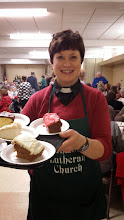
- I'm a proud 2011 graduate of Lutheran Theological Seminary at Gettysburg and the Pastor of Christ Lutheran Church continuing the journey that God has planned. This is where I somewhat regularly contemplate the intersection of faith and the real world, and the tension between law and the Gospel. I am blessed with a wonderful husband, two Lutheran Chicks and Toby, our beagle/pointer mix! And now for the legal lingo:Views expressed here are mine alone, and do not represent the ELCA, LTSG, or any ministry context in which I serve or to which I belong. The names in my stories have been changed to protect the innocent, as have key facts. If the story sounds familiar perhaps it is because life experiences can be universal.
Showing posts with label ethics. Show all posts
Showing posts with label ethics. Show all posts
Monday, April 20, 2015


Saturday, February 15, 2014
Why is Jesus So Harsh?
This past week I was coming home after a full day of Bible
Club, distributing grocery bags and Table Church and my neighbor was standing on his porch asking, ”Can I have
communion and can you tell me the gospel reading for Sunday?” He has missed Table Church and was going to be away Sunday. It had been a
long day and frankly I was tired. My first response was to say the gospel was
Matthew 5 on killing, adultery and divorce and that I didn’t have any communion
at home. Yes, I know I really did say that at first.
I’d traveled long that day. I really didn’t want to turn
around and walk back to church and get the communion ready and walk back
again... About one whole minute later, I popped back outside and said-“ I’ll be
right back.” I went back and got wine
and wafers and as I came back, he apologized if I had gone to any trouble. But really,
how many people are so focused on Jesus that they would even ask? It seemed
necessary. And it was for both of us.
I set up communion in the dining
room and started reading this gospel lesson from Matthew. As I read it frankly
all I could imagine was someone hearing it who needed some good news and it's murder, adultery, divorce, hell fire. It’s
harsh. And I almost felt like I needed to resolve it in some way. So I talked a
little about how sometimes as a parent and even before that as a child there
have been the “hard conversations” where the niceties get stripped away and we
tell people straight up truth not only about love but owning our actions. And
how all the rules we had for our kids were about showing them how to live in
life and love. Our “law” wasn’t about creating a game no one could win. The
words themselves might sound harsh but they have a purpose. That sounded good.
Then I pointed out that it’s easy to hone in on the sexy
words of divorce or adultery or the fierce words of murder where lots of judging
happens and say- well I didn’t do THAT! But Jesus is speaking about things much
more broadly- the ways we are all somehow drawn into the scope of words that
kill, promises broken, lives shattered ad hearts that are grieved. Not just
where we are victims but actors. And you know, when Jesus puts it that way, it’s
pretty hard to be judgey. We want to believe that our relativism or comparison
strategies count. It stings to be reminded that none of us is who we were
created to be or even wanted to be. And that sounded good too.
Well, then I suggested that the good news is there is more
to the story- that though we cannot live up the law, God’s grace in the cross
is the last word. And although that’s
true it kind of fell flat.
Luckily I think he wasn't listening to that. Because he was emotional and said hearing those words from Matthew
were just what he needed. He had felt someone was a little insulting and sarcastic,
so he had been a little salty back. Reflecting later he realized that the other
person might not have understood and he needed to make it right. He wasn’t
focused on “just get to the grace.” He was focused on the ethics. And it really
wasn’t a terrible thing he’d said, but he looked for a time to work together
with this person where they both volunteer to have a conversation to clear the
air and tie up loose ends.
And then he shared that it felt good to do that. Hearing Jesus’ words about our
ethics, affirmed not just what he had done but to keep doing it. Keep choosing to
transform something rather than just let it go. We really do need that
accountability. This is what Jesus is getting at. One scholar I know says,
following Jesus means doing what Jesus says which is MORE demanding than other
paths. And it is about community. Just appealing to grace won’t cut it.
And I think I played the grace card because I felt guilty about my earlier words.
We can opt for recognizing and trying to gloss over our human
failure but Jesus goes to the root- our motive and attitude matter. And the
justice and righteousness of which Jesus speaks- God’s transformative will-demands
confronting and changing the status quo in all of us.
When we do not live this way, we are
not participating in the completion of God’s purposes.
The law is not about
pleasing God, it’s what’s given for our life- all of us. More than a negative
goal of avoiding sin. But a positive one of discovering and following what is God’s
will. The sting we feel is not that God’s being harsh, its our experiencing the
potential for pain and destruction our brokenness brings and seeing our role.
All the examples Jesus gives show that destructive
expressions kill. Angry thoughts, words of contempt, insults, public shaming,
emotional abuse, disgrace. Choosing to demean and discard. We want to hear these
are not as bad as killing. But we know in our hearts how these destroy and cause loss of life. Even when we think it’s a little thing, we are
sacrificing each other in ways that harm more than we know and break our
connectedness. God calls us to keep each
other focused by giving us this community.
When we are not reconciled in relationships
we find life lacking. But the work of tending relationships is not convenient. The
story of leaving the sacrifice imagines journeying 80 miles to do something only
to turn right around and journey back the same distance and another week to participate
in mending a rift. Much farther than a block. That’s how far we should go to
avoid allowing bad in relationships to remain unresolved. Or risk someone
feeling lost altogether.
It shows the importance of relationships to God and what Jesus shows is what God gives for us. For life. We don't find life in the comparison strategies or relativism we want to rely upon. Even in what lots of people gravitate to- the part about divorce.
Jesus is speaking to protect dignity so that no one is demeaned or cut off. In
Jesus’ day marriage was a male prerogative in which destructive behaviors included
victimizing women to abandoning them for things as simple a thing as spoiling a
meal. Jesus proclaims that destructive
behaviors undo the “One flesh-ness” of
marriage. Even here, no matter how we try, none of us perfectly escapes times we undo
the one body-ness of many relationships in some way.
And living with perfection is beyond our grasp.
This is where Jesus continues to come to show us and lead us
into new places and to offer forgiveness. In seeing our brokenness then we
grasp the power and love of the cross. And the strength to try again to live into
the ethics of the kingdom. Where we show and experience God revealed. Together. In all
our thinking, speaking and living. Even the simplest words.
My neighbor didn’t need to share his
experience with me- he could have kept it to himself. He shared because he had a need. But it wasn't for me to
make Jesus more palatable. He and I needed to hear Jesus say again that doing the hard work
of relationships was holy and that God’s word, communion and fellowship are
where continually we meet the God who promises to lead us not into temptation
or the destruction of evil, but into the kingdom. My neighbor said at the end that when
he is away from church too long, he can feel it. That he needs it. We all do.
And the other day he saw I was stressed and called out, “Pastor,
just remember Matthew 5. “
Wednesday, December 2, 2009
Building an Ethical Economy

Does Theology Have a Role In Shaping a New Economy?
Trinity Lutheran Church in Lancaster, Pennsylvania is hosting a webcast of Trinity Institute’s 2010 Conference in conjunction with St. James Episcopal Church to ponder this question. Leading theologians and economists will discuss the relationship between economics and Christian belief and action, with reflection by participants as well.
Topics include:
• Theology & Economics: Two Different Worlds?
• Is Capitalism a Belief System?
• What Is Wealth?
• What Do We Owe the Future?
Speakers include Rowan Williams, Archbishop of Canterbury, Kathryn Tanner, Sir Partha Dasgupta, and Bernard Ntahoturi. More information at:
When: January 28-29, 2010
Where: 31 S. Duke Street, Parish House
Time: 9 am to 5 pm each day
Registration Cost: $30 inclusive for both days (includes snacks, beverages and lunch each day). Seminarian discount $15
To register call the church office at 397-2734 or by email to vicar@trinitylancaster.org
DEADLINE January 15, 2010
For more information visit:
Subscribe to:
Posts (Atom)